Thursday, June 18, 2009

"To Whom It May Concern" by Priscila Uppal


Published by Doubleday Canada

Uppal has written, with To Whom It May Concern, a particular kind of work which incites an intellectual rather than a visceral response, a novel that provides a sophisticated and intricate analysis of four family members, each of whom is presented in a manner singularly appropriate to relaying some insight, but about whom I could not give a damn.

The novel is impressive in its meticulous construction of a reality in which the Dange family resides. That is, it is exactly what I would expect from a scholar of English literature. This necessarily leads to a distinction between the scholar and the artist, the artist being that creature whose art is the result of some inspiration, who is more likely to describe his or her work as having a life of its own, of existing prior to its being concretized in the material novel. The work that the artist produces gives the reader a sense of something beyond, of encompassing the reader in itself, of leading him or her along the path which the artist his or herself followed in its creation, of engaging him or her in a natural logic beyond the mundane. In short, this novel brings up the plethora of discussion surrounding the difference between artistic gift and technical aptitude. While it is astounding in its technical proficiency, it fails to convey that something which is the difference between the work of art and the skilled reproduction. There is no hint here of the author’s intention.

The book centres around the various struggles of Hardev Dange and his three children, Emile, Birendra and Dorothy. Hardev is a partial quadriplegic intent on keeping his house despite the new developers’ plans for the neighbourhood. Emile discovers his attraction for his good friend Mohab. Birendra is getting married and, despising the idea of having children, covertly undergoes a tubal ligation. Dorothy is the youngest at 17 and deaf. While I enjoyed her story the most, I would not credit any real 17 year old with her characteristics (most notably her grammar, but also her tendency to create metaphoric names for herself and other objects). These characters’ stories co-mingle in the sense that certain life events lead them to similar conclusions regarding life and human psychology as perceived by Uppal.

I am certain that there are a great many people who will respond to this novel. I would recommend it highly to fans of James Joyce, but not to those who prefer Dostoevsky. Personally, I’m in the latter camp.

Tuesday, March 3, 2009

"Apologize, Apologize!" by Elizabeth Kelly


Published by Knopf Canada.

The subtitle reads "A Novel About a Family That Puts the Personality in Disorder". The first half of the novel seems to be about the "personality", and the second the "disorder". At first this novel seems to be about the Flanagan family and all their little quirks. While they seem lovable in that quirky kind of way, the reader can also discern an undertone of discord. The story is told from the viewpoint of the oldest son, Collie (named after the dog by his mother). Collie is by far the most average character of the novel, and he struggles to understand the rest of the Flanagan family from the standpoint of sanity. At times it seems the other characters are black boxes to Collie, like he doesn't understand the logic behind their actions any better than we do. At other times it's clear that he has at least become habituated to their strangeness. The reader can see that the characters, whom we might call eccentric and interesting were we unaffiliated with them, are at the same time alienating to a young boy (Collie at the beginning of the book, with whom the reader empathizes).

Around the middle of the novel tragedy strikes. To explain the story would be a disservice to future readers, as this passage is one of the most affecting of the novel. After so many pages of lightheartedness (strained, though it may be), Kelly manages to foreshadow disaster and express a great loss in one short series of events that seems both inevitable and unjust. We continue to follow Collie as he attempts to deal with the events, with minimal support from his strange and occasionally hostile family. By the end of the novel, he seems reconciled to the other Flanagans, but the reader isn't sure whether it's a harmonious reconciliation or whether Collie is admitting defeat.

The high-energy existence the Flanagans exhibit is reflected in Kelly's style of writing, peppered with internal references and metaphors that keep the reader at attention. I couldn't help but feel involved with this book, these characters. Reading this reminded me of the days when I only read classic, historically tested literature. Very highly recommended.

Thursday, February 12, 2009

"Something Drastic" by Colleen Curran


Published by Goose Lane.

I have a lot of good things and one bad thing to say about this novel. The writing is fun and energetic, and the characters are interesting and well-developed; but while the premise is original and could potentially provide fodder for much more hilarity, it’s difficult to maintain for the entire book.

From the back of the novel: “Lenore Rutland’s boyfriend of nearly eight years dumps her on Boxing Day and sneaks off to Florida.” The novel is a collection of letters written from Lenore to her departed boyfriend, who not once responds. In the beginning, this format adds a lot. I’m thinking particularly of Lenore’s list (in the first letter) of “List of Why I Think You Left Montreal.” This list is a hilarious expression of Lenore’s grief at the parting of her boyfriend. Though he never responds, Lenore learns further of her former boyfriend’s mischief through fraudulent credit card charges, investigation, and scumbags showing up at her door. The letters in which Lenore is directly addressing Fergie (John Ferguson, the runaway boyfriend) are undoubtedly the best parts of the novel.

There are many other letters, however, in which Lenore merely reports what she’s done recently, who she’s met, things that have happened, etc., and these letters defy explanation as to why she isn’t just keeping a journal. She does compare her letters to a journal at one point (excusing herself for continuing writing after he’s failed to respond for months), so the question stands: why doesn’t she just do that? This is where I think a little inconsistency in style (who says the novel has to be entirely in letter form?) would benefit the work as a whole.

The problem with making Lenore do something not as believable as it could be detracts from her character just a tad, and she’s quite the character. Throughout the novel she clips articles from the Montreal Gazette to send along with her letters to Fergie, explaining how they apply to him. For example, “Bear Tries to Eat Man’s Head” is a lesson to Fergie that men shouldn’t be mean without expecting retaliation. You can feel both her anger at his parting and her repression of that anger (usually through humour) throughout the novel.

So, my advice to literature seekers would be to get this novel, to read it, and to not get too hung up on the letter format. It only causes over-analysis.

Tuesday, February 3, 2009

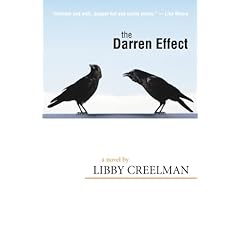
"The Darren Effect" by Libby Creelman


Published by Goose Lane.

Heather is grieving her recently deceased lover, Benny, when she goes on a mission with her sister Mandy to spy on Mandy’s old roommate, Darren (her sister is planning to write something about lost chances). Meanwhile, Benny’s widow (Isabella) has just moved in across the street from Darren. Heather and Darren eventually get together, and Darren and Isabella become friends. Their lives are not really intertwined, per se, but they do all come together near the end (at a barbecue).

The plot, however, does not seem to be the focal point of this novel (and I say that with surprise and delight). Most of what happens does more to reveal character than it does to drag the reader along some meaningless string of events towards an inevitable conclusion⎯sorry, I’ve been reading a lot of pop chick lit lately. Creelman’s characters are already in the midst of living their lives when the reader comes in. Her style is immediately engaging and gives the characters depth.

They’re also quite funny at times, but I find it hard to agree with the “devastatingly funny novel” claim on the back of the book. There is definitely humour in it, but it’s the kind of humour that only unhappy people seem to get. Overall, Darren lives with a demanding, paranoid sister, has an odd neighbour and somebody following him around; Heather loses her lover and almost her feet as she stalks Darren (and, oh yeah, she’s pregnant with her dead lover’s baby); and Isabella has a shopping addiction, a weird son, a dead unfaithful husband, and a smelly house due to an incontinent dog. If the reader isn’t used to finding humour in those kinds of situations (i.e., if they live in a bubble full of happy gas—you know the type), he or she probably won’t get the jokes. I laughed when Heather asked Darren if the Bruce Effect had ever been observed in humans. The Bruce effect is the tendency towards reabsorbing a fetus if the mother is exposed to a new male. That is, Heather is exposed to Darren and wonders (hopefully, it seems) whether it’s possible for the baby to be reabsorbed (in the third trimester, no less).

Overall, The Darren Effect is engaging; the reader is driven forward with interesting characters that one is eager to learn more about. Reading the book is like being gradually let into their lives, each interaction or reminiscence providing insight into their psyches. The great thing about it is that they do seem to actually have psyches; they’re realistic to the point where the reader assumes a life leading up to the point where the novel begins, and one that continues after it ends.

Tuesday, January 27, 2009

"Chloe does Yale" by Natalie Krinsky


Published by Hyperion Books.

"Sex and the City: The College Years"

Chloe Carrington is a junior at Yale, where she writes a column for the student newspaper called "Sex and the (Elm) City". She has some main friends--the slutty one, the prudish one, the intellectual one, and of course, the one gay male--as well as some that come into play whenever their presence is convenient to the plot. The novel is arranged episodically, each chapter having little to do with preceding or following chapters, and each chapter finishes with a column inspired by the events that transpired in the chapter. The one running plot is uninteresting and predictable: Chloe receives a series of online comments on her column (and later, emails) from a mysterious admirer who is, of course, the boy she knows from high school who's always been in love with her and whom she's never been able to consider seriously. (If this wasn't already spoiled by the obviousness of it all, I might have said "spoiler alert" above.)

The chapters proceed with little sense of the time that's past, though at the beginning it's September and at the end it's the following summer. In each chapter, Chloe does something--goes to a football game, plays poker, goes to a naked party, discovers her old boyfriend is now engaged, whatever. If I didn't know better, I'd think I was watching television but again (as I've stated in a previous review), on television I have actors to express character and emotion, whereas Krinsky leaves that kind of trivial thing up to the reader to superimpose on the bare bones stereotypes she's provided. Chloe is, of course, an average of all of the caricatures that surround her, with the added average traits as, of course, a penchant for shoes and the tendency to express how average she is at any opportunity.

Where Krinsky gets points, however, is where she unapologetically makes literary references without explaining the exact origin, the significance, etc., allowing me to believe that she assumes not everyone reading the book is an idiot. I would expect these references, given that the book takes place at a college, and that Chloe has survived at least two years at Yale, and I am not disappointed. Still, that only upgrades the book from "Sex and the City: The College Years" to "Sex and the City With Characters Who Read".

Thursday, December 18, 2008

"The Almost Archer Sisters" by Lisa Gabriele


Published by Random House of Canada.

The Almost Archer Sisters is a smart novel about the dysfunctional relationship between two sisters. I really enjoyed this book. The characters are complicated and endearing, and their problems intertwine in such a way as to provide a realistic vision of sibling relationships.

Peachy and Beth are sisters who grew up on a farm in a small town just north of the U.S. border. While Beth left for New York to go to college, Peachy stayed, having gotten knocked up by Beth’s old high school boyfriend, Beau. Peachy married him and bore two children, Sam and Jake. After the first chapter, a recount of Beth leaving for college, we find Peachy in the park with her sons. Later, we find out she’d gone there at 4 in the morning after finding her Beth and Beau going at it in the pantry. Flashbacks abound in the first half of the novel, retelling key occurrences in the girls’ lives⎯their mother’s suicide, their estrangement from their grandmother, Beth’s shady birth (her mother and Lou, with whom she grew up, crossed the border just after Beth was born, Lou dodging the draft; her real father had been killed in Vietnam). These tales come naturally, like a stream of memories rather than the insertion of plot exhibition. Later, the story continues: Peachy returns from the park, and determines to continue with her and Beth’s planned trip to New York⎯without Beth. Effectively, the girls switch roles, Peachy going to the city and spending time with Beth’s New York friends, and Beth left behind to care for Peachy’s family, but the fact that they learn to appreciate each others’ roles in life is beside the point.

What Gabriele managed to do in this book, is to create a realistic vision of interfamilial conflict. Peachy, instead of dropping everything and running off to New York (the crazed, scorned woman), has responsibilities to tend to. She has to return from the park, ensure her children are taken care of while she’s gone, give instructions to Beth, left behind, on how to complete her normal household duties (this results in two pages of detailed instructions, Beth attempting to interrupt the while, ending with Peachy’s hilarious finishing remark, “And kudos to you if you can find the time to fuck my husband again in between all that” [123]). These details put the reader right in with the conflict⎯nothing is assumed. It’s not just there-was-a-fight-now-the-obvious-follows kind of writing. Despite conflict, there are still things to be tended to, still people who need to be dealt with. After Peachy leaves, she doesn’t go on a vengeful tirade against her sister to her New York friends; she remains loyal to her sister, covering up for fibs Beth has told and refusing to disclose what Beth had done (until she figures out that everyone already knows, at least).

The book maintains an internal logic. The eccentric characters are eccentric, without being archetypes; the college dropout housewife is still allowed to be smart and insightful. The plot is completely unforced. The Almost Archer Sisters is one of the best novels I’ve read in a while and contains some of the most realistic female characters I’ve encountered.

Monday, December 15, 2008

"Proof of the Illuminati" by Seth Payson


Pubished by Invisible College Press

I have the heart of an infidel, and here’s proof:

[Premise 1] Seth Payson asserts on page 184 that, “the man [or woman, I assume] with whom these considerations have no weight, is a stranger to the nature, excellence, and importance of Christianity, and has the heart of an infidel.
[Premise 2] I am a woman with whom these considerations have no weight.
[Conclusion] Therefore I have the heart of an infidel.

Of course, I can only say this is because I believe in reason, as instanced in logic, which Payson states is an enemy of the Christian faith (along with philosophy, by which I’ve been corrupted). Payson would rather our beliefs were governed by the only true authority, revealed religion.

This book was originally published in 1802 under the title “Proofs of the Real Existence, and Dangerous Tendency, of Illuminism”. The topic of the book extends beyond Illuminism, as Illuminism is only a symptom of a more general tendency of modern society to conspire against Christianity. The true conspiracy began with Voltaire’s writings; Voltaire used his reason and philosophy to seduce the public away from the virtues of Christianity. Payson attempts, with this work, to uphold Christianity against the immoral attitudes of the Illuminati, stated to be “to prevent political and religious oppression” (26), which he interprets as an effort to abolish religion and the state (“the subversion of every social, moral, and religious obligation” [26-7]).

The further I read into this book, the more I identified with the Illuminati, whom I began to see as the victims of oppression, as the rightful revolutionaries, as the proponents of the intelligent use of reason. Payson’s main goal of this work is to defend Christianity against these evil-doers. To say that Illuminism is evil is all well and good until we attempt to define evil. Payson seems to take it as given that certain dictates of Illuminism are self-evidently evil. By doing this he assumes a value-set with which I cannot agree. Payson describes the evils of the lodges: “sensual pleasures were advocated, and self-murder justified. That death was represented as an eternal sleep; patriotism and loyalty were called narrow-minded prejudices, incompatible with universal benevolence. Nothing was so frequently discussed as the propriety of employing, for a good purpose, the means which the wicked employed for evil purposes” (88). In order to agree that these are evils, we must hold the opposite assumptions, i.e., that sensual pleasure is bad, suicide is wrong, death is punishment for sin (heaven and hell exist), etc.

The book does not give any real proof of the Illuminati per se, but descriptions of the organization of the Illuminati as branching off of Masonry. For this he relies on two main sources, Robin and Barruel, from whom all his information is taken. It seems an incontrovertible fact that Illuminism did exist (founded by Weishaupt in 1776), but the question that remains is whether they were, in fact, evil and, as we’ve seen, that depends on how we define evil. Payson lists, towards the end of the book, some practices of the Illuminati (like drowning priests and babies) intended to horrify the reader, but it seems like he’s reporting on Satanic cults—no actual instances of such practices may have ever occurred.

Payson has some recommendations to prevent the Atheist revolution from coming about. Of course, it is of the utmost importance that anyone who is not a loyal Christian be denied employment in a pubic office (178). That would allow them to spread their evil further. Nor should clergymen attempt to convert them by making Christianity amenable to their views: they must accept Christianity as Seth Payson believes it to be. Children should be educated at home in the ways of religion and morality, as in the German universities “the chief study is the new system of philosophy, by which the mind is totally bewildered, and at length deprived of every solid principle of religion, morality or sound politics” (136, quoted from Appendix to Anti-Jacobin Review).

In short, I found this book to be less about the Illuminati than about how Seth Payson hates Atheists.